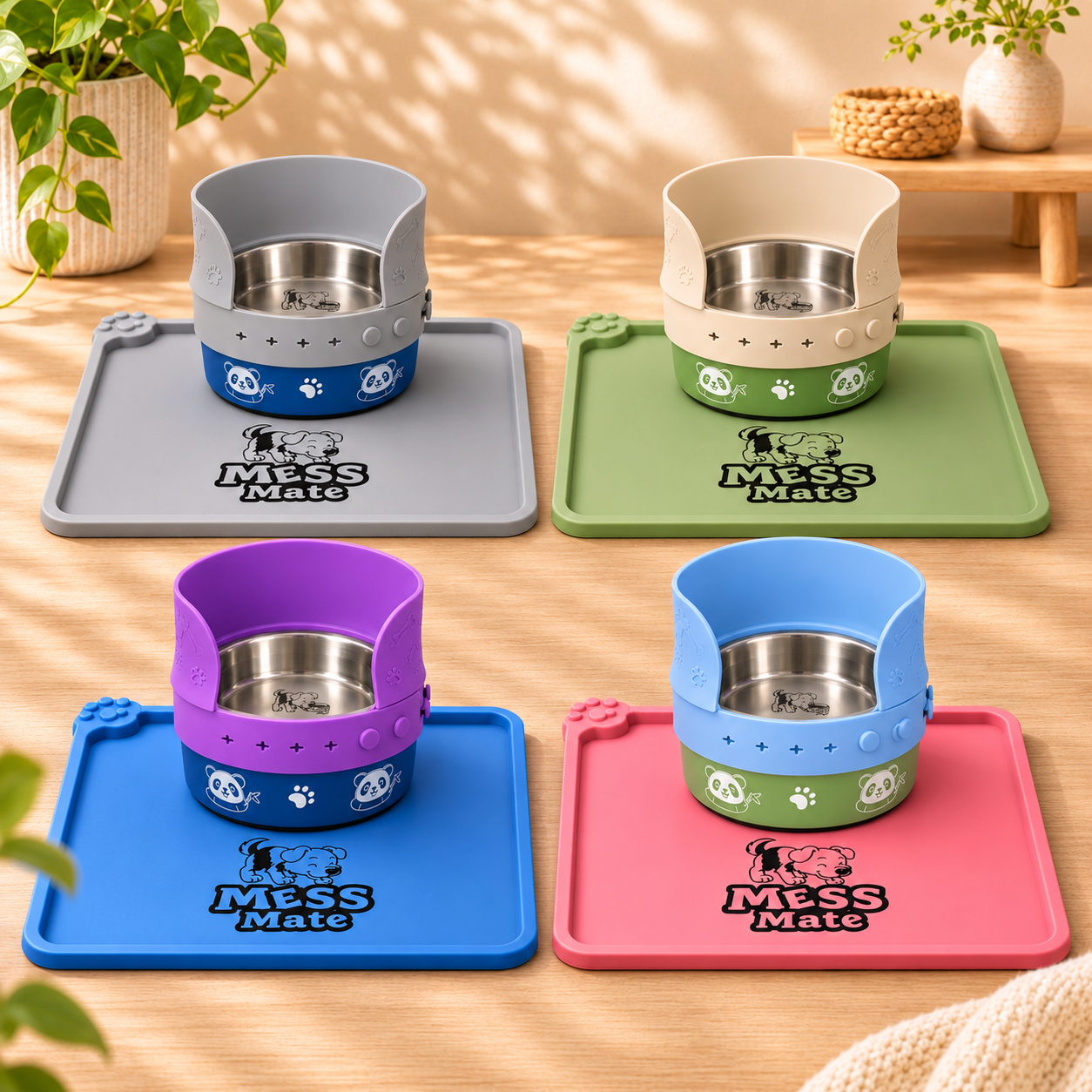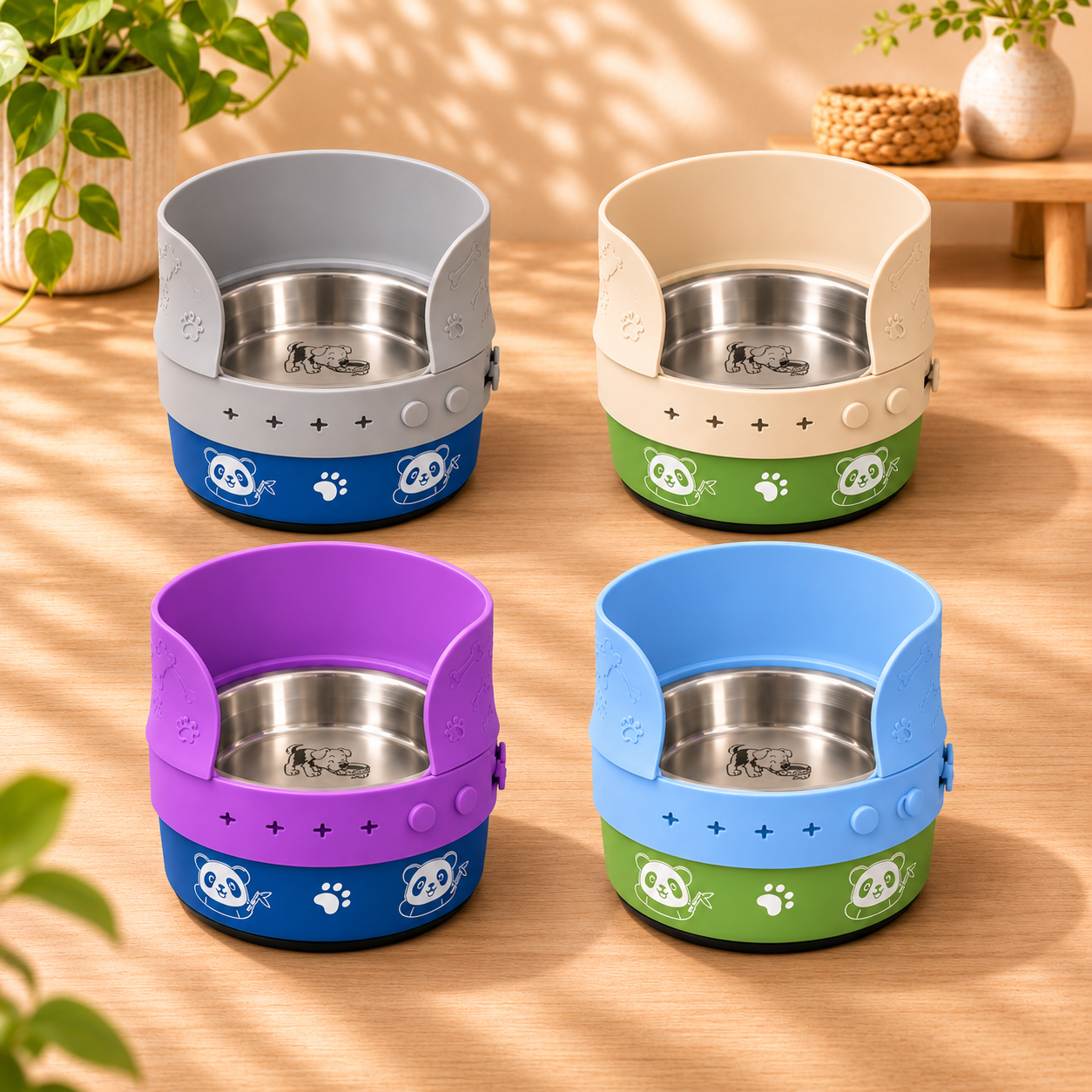
You fill the bowl, set it down, and by the time your dog finishes eating it has traveled halfway across the kitchen. A sliding bowl is more than an annoyance. It drags kibble and water along with it, scuffs the floor, and sometimes ends up wedged behind a chair leg. This guide explains why bowls slide, what you can try to keep one in place, and where the limits of each fix are.
Why dog bowls slide in the first place
Sliding usually comes down to three ingredients: a smooth bowl base, a smooth floor, and a dog who pushes. Remove or soften any one of them and the problem tends to shrink.
The bowl
Stainless steel, glazed ceramic and hard plastic all have very little friction against tile, laminate or sealed hardwood. Lightweight bowls move more easily than heavy ones, and a nearly empty bowl moves more easily than a full one. That is why the sliding often gets worse toward the end of a meal, when only a few pieces of food are left.
The floor
Kitchen tile and polished hardwood are the slipperiest surfaces. Low-pile rugs can bunch up under a bowl, which creates a different kind of mess. A floor that is slightly damp from splashed water makes sliding even more likely.
The dog
Many dogs nudge the bowl with their nose, paw at it, or lick it around the floor to chase the last bits of food. For most dogs this is ordinary instinct and not a behavior problem. If your dog suddenly starts pushing the bowl much more than usual, seems to struggle to reach the food, or drops food while eating, mention it to your veterinarian, because discomfort in the mouth, neck or joints can change how a dog eats.
Practical ways to keep the bowl where it belongs
1. Give the bowl a defined spot with a feeding mat
A mat under the bowl marks out a feeding zone and catches crumbs and drips that would otherwise land on the floor. Our silicone pet feeding mat is made from food-grade silicone and goes in the dishwasher on the top rack, so cleanup is easy. To be straightforward about it: no mat can promise to stop every bowl from moving on every floor. Try it with your own bowl and your own dog, and see whether the bowl stays put through a full meal. You can browse more options in our anti-mess feeding mats collection.
2. Choose a bowl base that suits your floor
Some stainless steel bowls have a rubber or silicone ring around the base, which adds friction. Others have a flat bare-metal bottom. If you are shopping for a new bowl, check the base before you check the color. You can compare sizes and styles in our stainless steel bowls collection.
3. Use a corner or a wall edge
A bowl placed in a corner has fewer directions to travel. Placing it against a baseboard can also stop the slide, although it may put the wall in the splash zone. We cover the trade-offs of different spots in where to put your dog's food bowl for a tidier kitchen.
4. Consider a heavier bowl
Heavier bowls, such as thick ceramic, resist pushing better than thin metal ones. The trade-off is that ceramic can chip or crack if dropped, and chipped glaze is worth replacing. A heavy bowl also does nothing about splashing or flying kibble.
5. Keep the feeding spot consistent
Dogs that know exactly where meals happen tend to settle into a routine. Feeding in the same place, on the same surface, makes it easier to spot what is working. It also keeps mess in one area you can wipe down in a minute.
Where a splash guard fits in
A splash guard solves a different problem than sliding, so it helps to be clear about what it does and does not do. The MessMate splash guard fits round bowls that are 7 to 9 inches across the top opening, and it has a 3-inch silicone wall that helps keep food and water inside the feeding area when a dog is enthusiastic. It is not a fix for a bowl that slides, and it does not change how fast or how roughly a dog eats.
It also has a firm size range. It is not suited to bowls under 7 inches or over 9 inches across the top opening. Before you buy, measure the opening from inside edge to inside edge. Our fit guide walks you through it. If you would rather not measure at all, the bowl and splash guard set pairs the pieces so they fit together.
Keep the area under the bowl clean
A bowl that slides around tends to leave a film of water, saliva and food oils wherever it has been. Wipe the feeding area daily and wash mats and bowls on a regular schedule. Silicone and stainless steel pieces from MessMate are dishwasher safe on the top rack. If you notice odors or a greasy feel, our guide to cleaning silicone pet bowls, guards and mats has step-by-step tips.
A quick checklist
- Check what the bowl base and your floor are made of.
- Add a mat to define the feeding spot and catch crumbs.
- Try a corner or wall edge if the bowl travels in open space.
- Watch whether sliding gets worse as the bowl empties.
- Ask your veterinarian if your dog's eating habits change suddenly.
The bottom line
A sliding bowl is usually a friction problem plus a dog who is doing what dogs do. A mat, a better base, a corner spot or a heavier bowl can each help, and combining two of them often works best. If splashing and spilling are part of your mealtime mess, a splash guard and mat can help contain it. Every order ships free in the U.S. with 30-day returns. Use LOYAL15 for 15% off your order. MessMate also donates to animal-rescue groups in memory of Spud.