Search for a way to tidy up your dog's mealtime and you will find three main options: trays, mats and splash guards. They sound similar, but each one handles a different kind of mess. Choosing the wrong one for your problem can leave you just as frustrated as before. This guide explains what each does well, where each falls short, and how to decide which one, or which combination, suits your home.
Start by naming your mess
Before comparing products, work out where the mess actually lands. A few quick questions help:
- Is the mess mostly on the floor around the bowl, such as dripped water or dropped kibble?
- Does it fly sideways, with splashes hitting the wall or cabinets?
- Does the bowl itself move or slide?
- Is the floor surface itself the issue, such as hardwood or carpet that should not get wet?
Your answers point toward different tools.
Bowl trays
A tray is a shallow, rimmed platform that the bowls sit inside. Its job is to catch whatever escapes and hold it in one place until you lift the tray and empty it.
Where trays do well
- Catching drips and spilled water close to the bowl.
- Holding two bowls together, one for food and one for water.
- Giving you a single piece to pick up and carry to the sink.
Where trays fall short
- A rim only holds liquid that lands inside it, so splashes that fly past the edge are not caught.
- Full trays of water can slosh when you carry them, so lifting needs a steady hand.
- Some are bulky, and the corners can be fiddly to clean.
Feeding mats
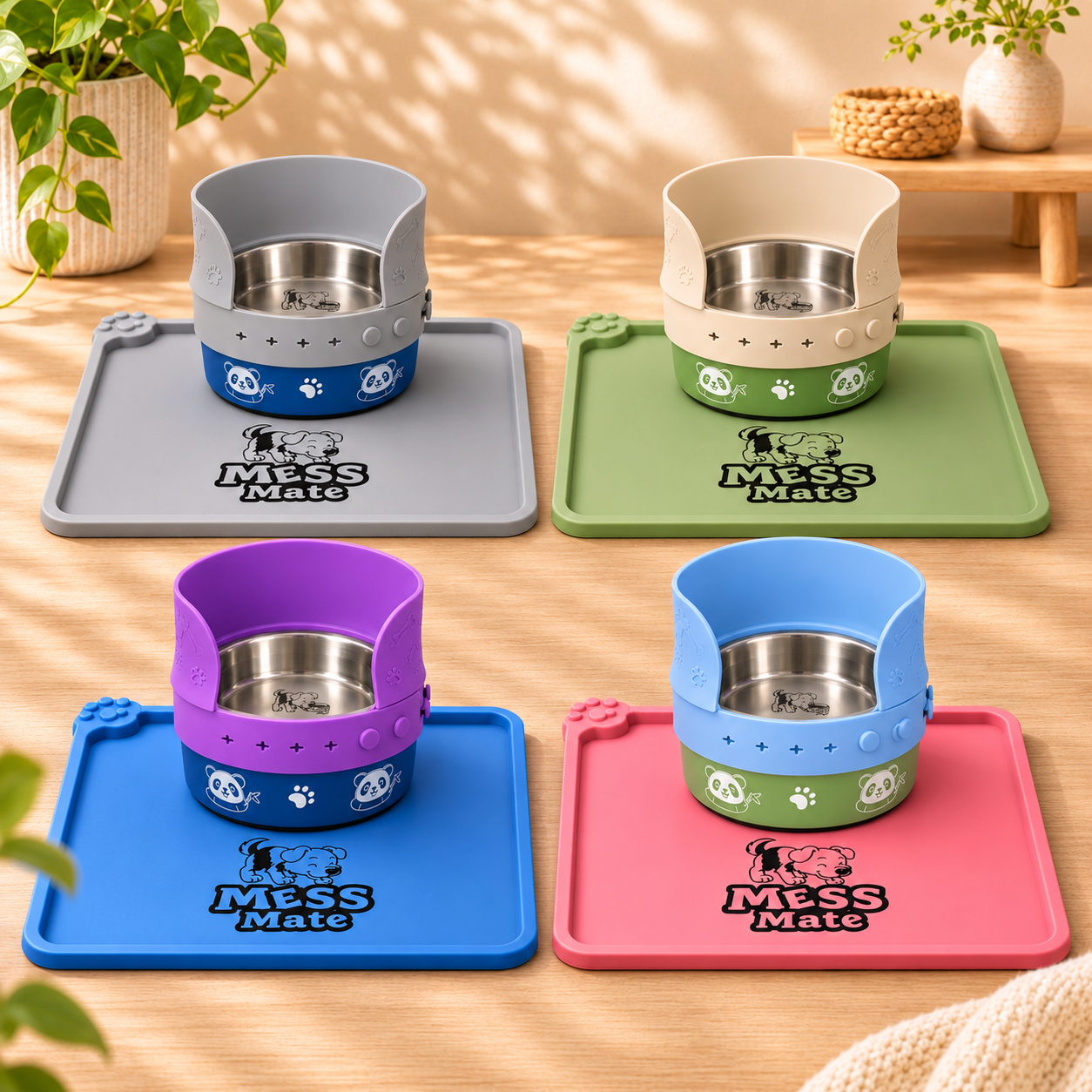
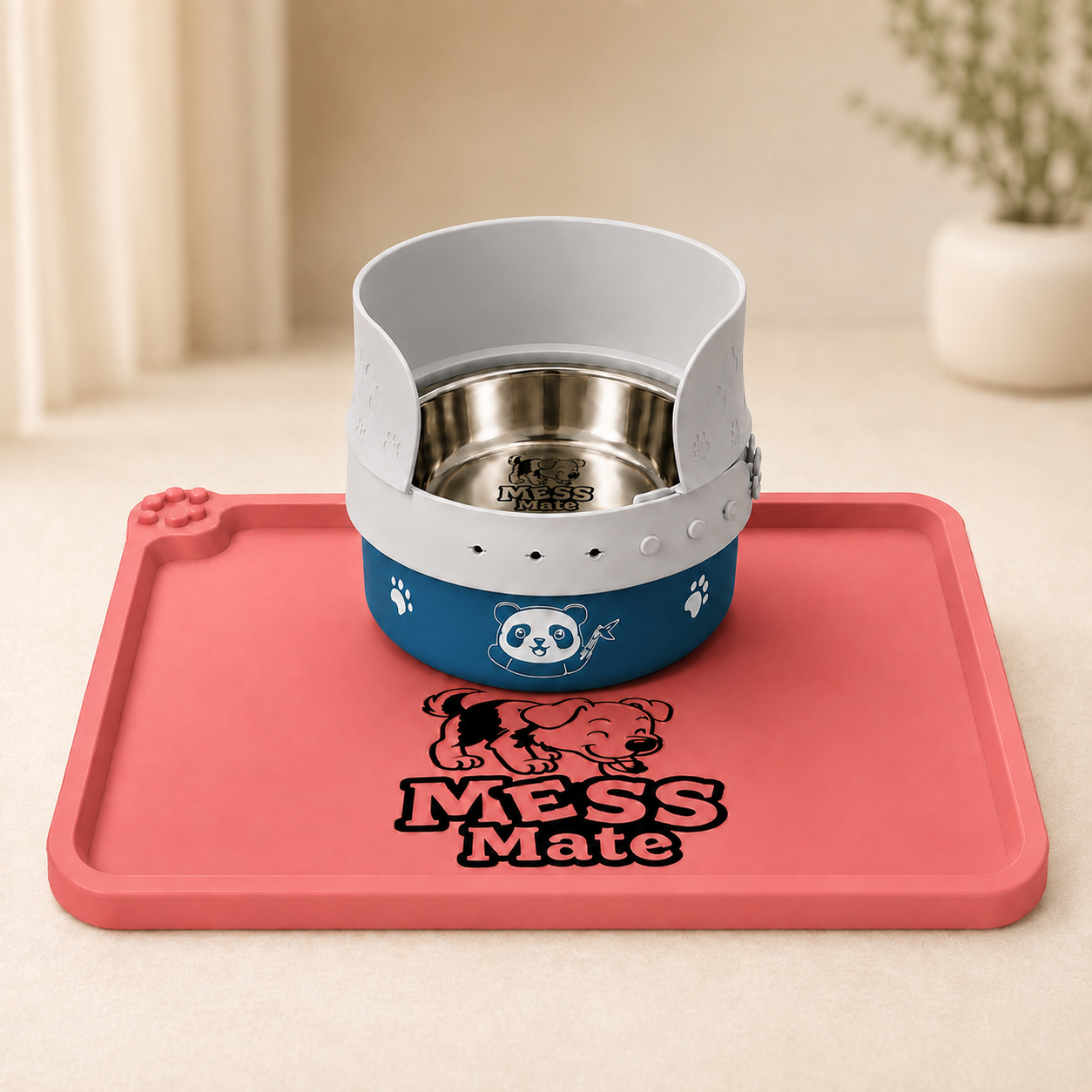
A mat is a flat sheet that sits under the bowls. It protects the floor and defines the feeding area. Mats come in different materials, and not all of them are easy to clean, so it is worth choosing one you can rinse or put in the dishwasher. MessMate's mat is silicone, which is food-grade and dishwasher safe on the top rack.
Where mats do well
- Protecting the floor from drips, crumbs and drool.
- Giving the bowl a defined spot, and often more grip than a bare floor.
- Making the feeding zone obvious to your dog and to anyone walking by.
- Being simple to pick up, shake out and wash.
Where mats fall short
- A flat mat is not a barrier. A large puddle or a vigorous splash can still travel off the edge.
- It will not stop water from reaching the wall beside the bowl.
- It does not keep kibble inside the bowl, only catches what falls out.
If you want to see what is available, browse the silicone pet feeding mat.
Splash guards
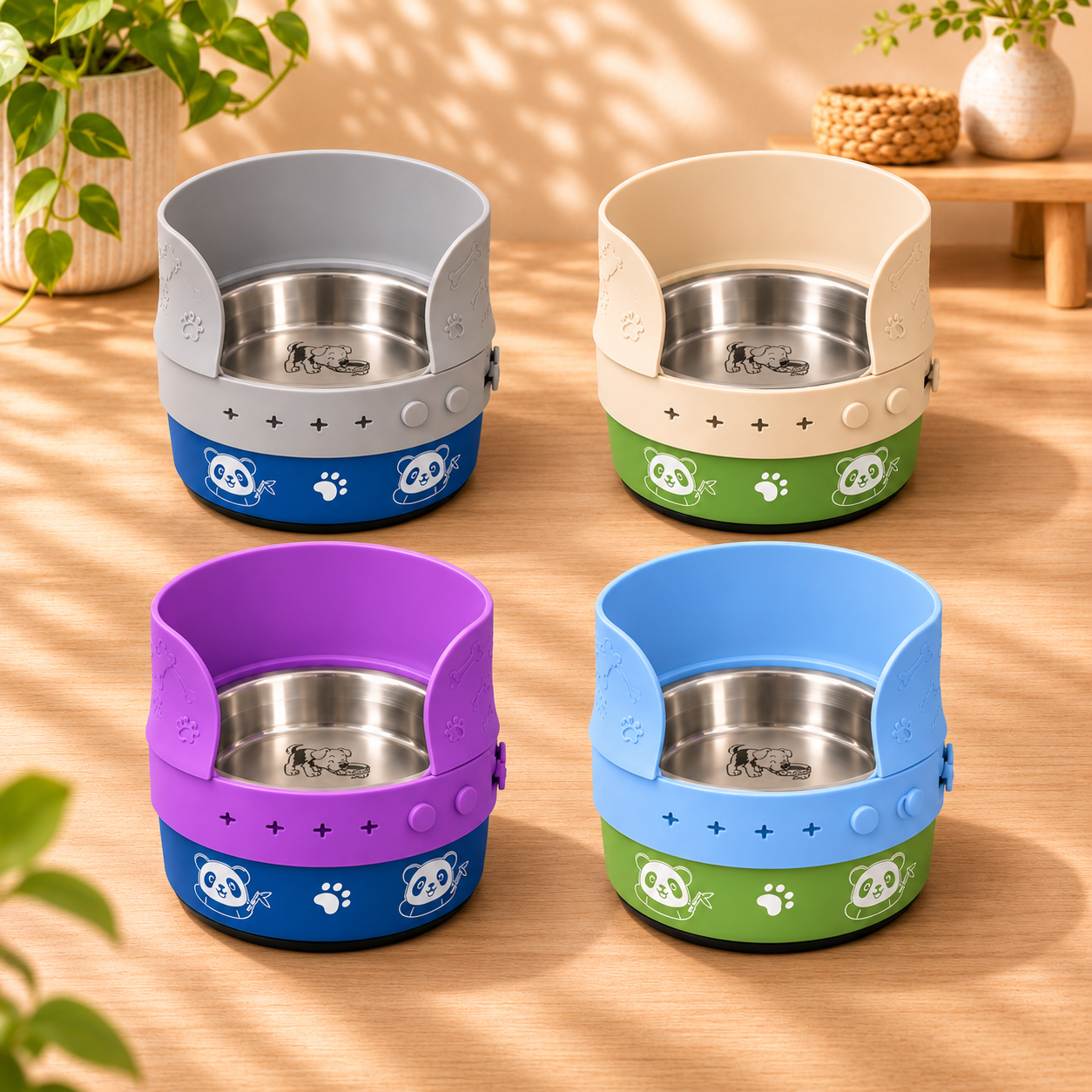
A splash guard attaches to the bowl itself and acts as a raised wall around it. Instead of catching mess once it has landed, it tries to keep it from leaving the bowl area in the first place.
The MessMate splash guard clips around the outside of a round bowl with its strap and has a 3-inch silicone wall. It fits round bowls that are 7 to 9 inches across the top opening, which makes it suited to medium to extra-large dogs and large cats. It is not suited to bowls smaller than 7 inches or larger than 9 inches. The guard sold on its own does not include a bowl.
Where splash guards do well
- Blocking water that gets flicked or splashed sideways, which helps with walls and cabinets.
- Keeping kibble nudged out of the bowl closer to where it started.
- Reducing how much drips from a dog's chin onto the floor beyond the bowl.
Where splash guards fall short
- It cannot fix eating speed or behavior. A dog that gulps food or flips a bowl will still do so.
- Drips that land below the bowl, or from a wet muzzle after the dog steps away, still reach the floor.
- It only fits bowls within the size range, so measuring matters. Our fit guide walks through how to do that.
You can browse the options on the splash guards page or look at the bowls and splash guards product.
Side by side
- Best for drips on the floor: a mat or a tray.
- Best for sideways splashes: a splash guard.
- Best for protecting a delicate floor: a mat, ideally with a guard on the water bowl.
- Best for keeping the whole setup in one place: a tray or a mat, depending on your preference.
- Best for easy cleaning: whichever piece you can put in the dishwasher on the top rack.
Why combinations often work better
Because each option addresses a different kind of mess, using two together often covers more ground than one alone. A splash guard on the bowl reduces how much leaves the bowl, and a mat underneath catches what still gets out. For many households, that pairing handles the bulk of everyday mealtime mess without a lot of extra equipment.
If you are starting fresh, a matched set saves you from checking measurements and mixing colors. The bowl and splash guard set pairs the two pieces that need to fit together, and the complete mealtime set is a good place to begin if you want everything in one go.
Things no accessory will fix
It is worth being straightforward: none of these products changes how fast a dog eats or why a pet behaves the way it does. If your dog gulps food, drinks very messily, or suddenly changes eating habits, talk to your veterinarian, who can advise on behavior and health. Accessories are there to make cleanup easier, not to stand in for that kind of advice.
Making the choice
- Identify where your mess lands: floor, wall or both.
- Match the tool: mat for the floor, guard for sideways splashes, tray for liquid containment.
- Check your bowl size before choosing a splash guard.
- Choose pieces you can wash easily, because the one you clean is the one you will keep using.
- Combine two pieces if one is not enough.
If something does not work out, purchases come with 30-day returns, and the FAQ page covers common sizing questions.